
There’s nothing more uncomfortable than a water heater breaking down, leaving you with cold water when you least expect or need it! Whether you’re dealing with an unexpected breakdown or have planned for some time to upgrade the whole system – choosing the right water heater is key.
Whether it’s installing a new or replacing an old water heater, compare all information first. You’re in the right place to discover all the ins and outs of this type of purchase for your home in this comprehensive buyer guide below.
What Size Water Heater Do I Need?
When choosing the type of water heater, you first need to consider its size, as this determines its heating capacity and ensures it can meet your family’s hot water needs.
Let’s say you consider a tank heater (conventional or heat pump type). You need to determine how many family members will be using this, and you can estimate the needed tank volume (for gallons) based on that information:
- 1–2 people – around 30 gallons for normal/low demand, and 40 to 50 gallons for high
- 2–4 people – around 40 gallons for normal/low demand, and 40 to 50 gallons for high
- 3–5 people – around 40 gallons for normal/low demand, and 50 to 75 gallons for high
- 5 or more people – around 50 gallons for normal/low demand, and 75 gallons for high
Besides tank capacity, you also want to calculate the FHR (first-hour rating). FHR tells you how much hot water you can get from the tank in just one hour of heating it gets. This tells you how efficient the water heater is in peak use (especially when you are in a hurry and need to shower, for example!).
For you to estimate the demand in peak hours, first decide when in the day you use hot water the most (morning, noon, night). After that, you can use various accessible charts or calculators to find out how much of this you use. But, let’s take a look at rough numbers:
- Washing hands (per person): around 2 gallons
- Bathing or showering (per person): around 20 gallons
- Washing hair (per person): around 6 gallons
- Running washing machine: around 30 gallons
- Shaving: around 3 gallons
- Running the dishwasher: around 14 gallons
If someone from your family showers in peak hours, and another is washing hands, but you also loaded the dishwasher and maybe laundry too, then don’t look for anything below 66 gallons FHR minimum (20 + 2 + 14 + 30 = 66).
Now, let’s say you have a tankless water heater. These are super convenient because they will heat the water when needed, and they don’t store it endlessly. Pay attention here to the needs of your household, the desired temperature, and the flow rate.
Let’s first determine the peak hot water demand. For this, you need to list all the appliances and fixtures that you use simultaneously. There is a flow rate for each of these, measured in GPM (gallons per minute):
- Dishwashers: 1-2 GPM
- Washing machines: 2-2.5 GPM
- Showers: 2-3 GPM
- Kitchen sinks: 1-1.5 GPM
Now just gather all sums from all fixtures and you get a total flow rate. Easy as that!
Next, you need to determine the rise in temperature. Try to estimate how much cold water is used in your home (this will often depend on the season and region), but let’s say circa 50°F. Now set your desired temperature (usually for most appliances this is circa 110-120°F).
Do you want to know how to calculate the rise in temperature? It is easy, just subtract the incoming water temperature from the desired one. If the incoming is at 50°F, but you want 120°F, the total calculation for the rise is 70°F.
Now it’s time to calculate the heater capacity after you did the math above. Look for the info from a manufacturer in matching flow rate and rise in temperature. Here is one simple formula in BTUs:
Heater Capacity (BTUs/hour)=Flow Rate (GPM)×Temperature Rise (°F)×500
Let’s say you need a flow rate of 6 GPM and a temperature rise of 70°F, then:
6 GPM×70 °F×500=210,000 BTUs
If we assume you have two showers (each of 2.5 GPM), a dishwasher (1.5 GPM), and a kitchen sink (1.5 GPM) and use them at the same time, your flow rate will be 8 GPM. So if the incoming water is 50°F, and you want 120°F, you need a rise totaling 70°F. So, you would choose a tankless water heater that comes at a minimum of 280,000 BTUs (8 GPM × 70°F × 500) for peak demand.
Always ensure that you see the tools and charts of manufacturers if you want to find the ideal model for you. For the best results and help with this, consider consulting a local water heater service contractor to help you find the perfect fit for your home.
How to Choose a Water Heater
There are a variety of factors to keep in mind, such as:
- Fuel Source: Do you use gas or electricity, propane, or another fuel type?
- Type of Heater: Each type has its benefits and drawbacks that you must compare to make your best final decision.
- Capacity: Assess your home’s hot water needs first.
- Space Requirements: Consider where the water heater will be installed.
- Water Heater Size: Match the size of the water heater to your household’s demand.
- Quality Contractor: For all doubts, a reputable plumbing contractor from Ace will be happy to help!
Now that you know what to consider, let’s look at water heater types.
What Is the Best Water Heater?
This depends on the types of water heating energy they use and which you prefer for your specific home needs. Each type has its own advantages and considerations – it’s up to you to revise them, and we can further help you make the most of your decision and purchase.
Picking out better appliances to install in your household can be simpler when you get the right know-how and guidance.
It’s also important to consider the fuel your future water heater needs. Some options are more energy-efficient than others and help you cut down on costs. Gas and liquid fuel models, for example, lose a lot of energy because they need to ventilate a lot as well. So, remember to keep fuel type in mind before purchasing.
Electric Water Heaters
Electric water heaters use electric resistance coils to heat the water. This process is controlled by thermostats that regulate the water temperature on these electric models.
Pros
- Affordable
- Easy to install
- Clean
- Easy to maintain
- Suitable when gas or oil is unavailable
Cons
- Higher operating costs
- No hot water during a power outage
- Longer time to restore hot water
- Require electrical system upgrades
- For older homes: It may be needed to replace the electric panel and wiring to connect with high amps
Gas Water Heaters
Gas water heaters use natural gas or propane as a fuel source to heat water. When the thermostat senses that the water temperature has dropped below the desired level, it ignites the burner in gas models, heating the water directly.
Pros
- Provides more hot water / faster reheating time
- Faster reheating time
- Highly energy efficient
- Gas is cheaper than oil
- Operational during power outages
Cons
- Complicated to maintain and install
- Installation location constraints (depending on ventilation options)
- More components to handle when it malfunctions
- Requires regular flushing (unless you want sediment build-up!)
- Periodic gas line and cylinders checks (to avoid any leaks)
Oil Water Heaters
Oil water heaters use oil as a fuel source to heat water. The oil is stored in a tank and pumped into a burner to ignite and heat water in the tank.
Pros
- Faster heating time than other models out there
- Highly energy efficient
- Long lifespan
Cons
- Higher service and maintenance costs than gas/electric
- Additional cleaning needed
- More expensive to install than others
- Require constant fuel supply
Heat Pump Water Heaters
A heat pump water heater heats water by transferring heat from the surrounding air to the water in the tank. This type operates in two modes, providing flexibility in different conditions: 1) Heat pump mode 2) Electric resistance mode.
Pros
- Energy efficient (uses around 60% less energy than others)
- Eco-friendly
- Less maintenance
Cons
- More expensive than other types
- Large size (if your living space is quite small, this is a huge barrier!)
- Lower average lifespan
Storage Tank Water Heaters
Conventional water heaters (i.e., storage tank water heaters) are the most common type. They operate by heating water in an insulated tank, which keeps the warmth with its insulation.
Pros
- Lower initial cost
- Efficiency in any climate (tank is well-insulated to sustain any climate temperatures)
- Lower installation costs (simpler technology and less complex requirements)
Cons
- Increased energy loss
- Large size (not ideal for small homes)
- Vulnerable to water damage, it may leak or burst (a problem you don’t want at home!)
Tankless Water Heaters
Tankless water heaters (i.e., on demand water heaters) heat water directly without a storage tank. Here,a gas burner heats the water instantly, providing a continuous supply of hot water whenever you need it. There are many benefits of tankless water heaters, but let’s also compare all aspects:
Pros
- Instant hot water
- Space saving
- Highly efficient
- Lower monthly costs
- Affordable to install
Cons
- Higher initial cost
- Notable energy loss
- Large size
- Limited hot water supply
- It may be prone to water damages
With all this information on different types of water heating, their benefits, and their considerations, you can plan out your next water heater installation much better and more easily!
Water Heater Efficiency
Before you install a water heater, look at the EF (energy factor), or percent of energy turned into hot water. The higher this is, the better the device!
Yes, high EF is good, but you need to keep in mind the energy cost of heating water. If you are unsure, check the cost of operating the unit before other factors. Check this formula for the payback period if you compare the same FHR heaters but with different prices.
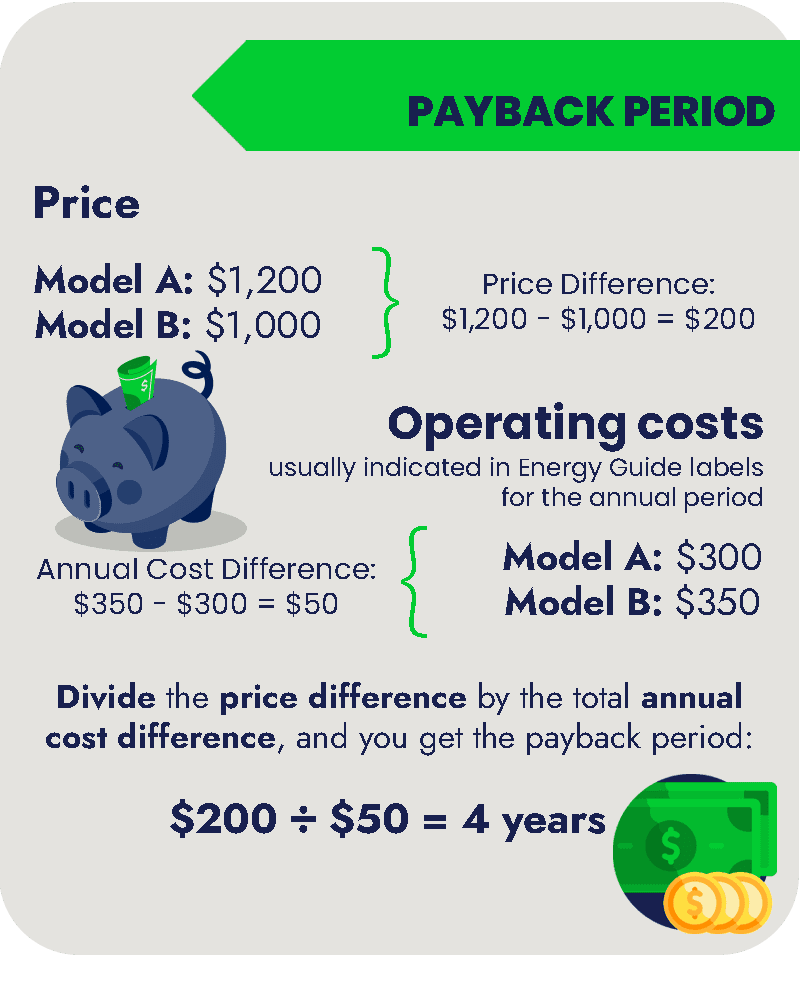
The number of years in the result means the energy savings will offset a higher purchase price in that amount of time. Ideally, you want to aim for a payback period of circa 10 years, which is the usual lifespan of a heater. If the cost of energy rises in the meantime, know that the payback period shortens!
Go Tankless!
Thinking of replacing your old water heater? Here’s why you should go tankless, in case you need the recap.
A tankless water heater replacement ensures you’re always getting hot water by instantly heating it as soon as needed rather than constantly keeping a large tank of water hot.
They’re also far more compact, durable, and energy-efficient than traditional units. You check out a few factors simultaneously with this option!
Bring on the Hot Water!
When choosing a new water heater for your home, make sure it’ll provide enough hot water for your family AND help you save energy and money.
If more than one fuel is available in your area, try comparing fuel costs, specifically if you are building a new home. Even if you simply replace your water heater, you can save more money in the long run by using a different fuel or energy source.